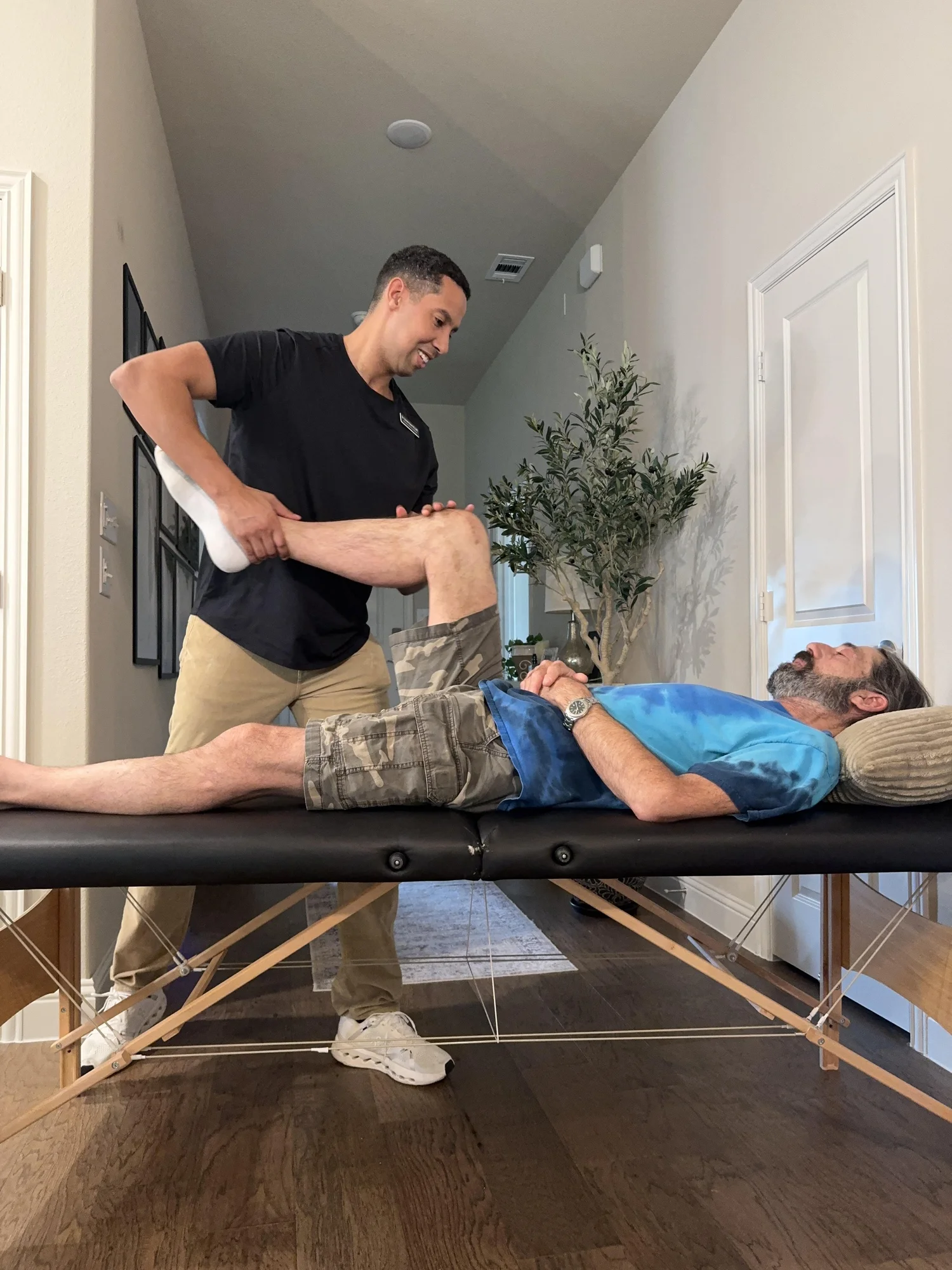
Walking after knee replacement
Walker to Cane After Knee Replacement: Readiness, Not a Date
A cane is not the prize for reaching a certain postoperative day. It is appropriate when it gives enough support for controlled walking across the places you actually use—without buckling, grabbing furniture, losing balance, or making the limp clearly worse.
- Symptoms are manageable
- Pain and swelling allow controlled weight acceptance without a growing setback.
- The knee is controlled
- The operated leg supports the step without sudden buckling, collapse, or a rushed escape.
- Balance is reliable
- You can start, stop, turn, and approach a chair without grabbing furniture or another person.
- Quality lasts
- The pattern stays safe beyond a few ideal steps and does not fall apart with ordinary fatigue.
My shortest answer
Use the least support that still produces your safest useful walk.
Do not change devices because a calendar, friend, or online recovery story says you should. Have the therapist reassess gait, balance, knee control, strength, symptoms, endurance, and the environments you need.
AAOS describes walking aids as tools that assist balance and make daily activity safer; a cane offers less support than a walker and must be fitted and used correctly.1
If walking becomes less steady, more painful, or more guarded with the cane, use the walker for that task and arrange reassessment. More support is a good decision—not a failure.
Why the change matters
A cane changes the balance and strength demand of every step.
A walker provides a wider base and lets both arms contribute. A cane provides much less support. Five good kitchen steps do not prove that the change will hold on a hallway, threshold, driveway, stair, or tired evening walk.
The operated leg accepts more work
The knee, hip, ankle, and trunk must control weight without a sudden collapse or rushed step.
The base of support becomes smaller
Turns, doors, obstacles, distractions, and low light can expose a need the straight hallway did not.
Quality must last
A device is only appropriate if gait remains safe across the distances and times of day that matter.
It can be appropriate to use a cane in one setting and a walker in another. Device progression does not have to happen everywhere at once.
Five readiness domains
Better walking matters more than a lighter device.
No single strength score, pain number, or day since surgery determines readiness. The whole pattern decides whether the cane is enough.
Pain and swelling
Symptoms do not have to be absent. They should be predictable enough that the device trial does not cause a large or progressively worse response.
Gait quality
Look for controlled weight acceptance, foot clearance, step rhythm, starts, stops, and turns without a clearly worse trunk lean, shuffle, or rush.
Balance
Check chair approach, backing, doors, furniture, direction changes, and distractions. Grabbing nearby surfaces is a meaningful sign.
Strength and knee control
The operated leg must manage body weight during stance, slowing, turning, and repeated steps without buckling.
Endurance
The result should hold during the actual room-to-room distance, appointment route, outdoor surface, or late-day walk you need.
A graded cane trial
Test the device, the person, and the environment together.
AAOS advises proper fit and typically holding a cane in the hand opposite the side needing support. Individual conditions can change the recommendation, so side, height, and technique should be confirmed during assessment.1
Start with the current walker
Observe the existing gait, device fit, symptom response, turns, and places where extra support is still used.
Check control before distance
Use transfers, standing balance, weight shifting, short steps, and direction changes before a longer walk.
Fit and practice the cane
Confirm the type, height, hand, sequence, and how the cane coordinates with the operated leg.
Test real barriers
Try the relevant doorway, threshold, bathroom approach, hallway, curb, or outdoor surface with supervision.
Add ordinary fatigue
Repeat enough activity to see whether the gait changes when the first fresh steps are over.
Define a mixed plan
Write where the cane is appropriate and where the walker remains the safer choice.
When the pattern worsens
Do not practice a poor cane pattern until it becomes familiar.
A worsening limp, repeated furniture reach, rushed step, new buckling, or balance loss means the current support may not fit that task.
Choose quality over pride. Returning to a walker for a difficult setting protects the better gait you are trying to build.
Physical therapy’s role
A device assessment should end with a clear map.
The result is not only “cane” or “walker.” It should specify fit, hand, sequence, environments, supervision, fatigue limits, stair plan, and the impairments that still need work.
What PT can determine
- Whether the cane gives enough support.
- The appropriate type, height, hand, and walking sequence.
- Where the walker remains safer.
- How gait changes with turns, surfaces, and fatigue.
- Which strength, balance, and walking exercises address the limiting factor.
What needs medical review
- New or increasing calf pain, redness, tenderness, or swelling.
- Wound drainage, opening, or spreading redness.
- A fall or twist with new pain or loss of function.
- New inability to bear weight or sudden repeated buckling.
- Sudden breathing trouble, chest pain, coughing blood, or fainting—call 911.
Frequently asked questions
Moving from a walker to a cane
1. How many weeks after knee replacement should I move to a cane?
There is no universal week. Readiness depends on the operation, prior mobility, strength, balance, gait, pain, swelling, medicines, home environment, and other health conditions. Progress after reassessment—not the calendar.
2. Which hand should hold the cane?
AAOS generally describes holding the cane opposite the side that needs support. Your therapist should confirm the side, fit, and sequence because another condition or task may change the plan.1
3. Can We use a cane indoors and a walker outside?
Yes. A mixed-device plan can fit when level indoor walking needs less support than uneven ground, longer distances, crowds, low light, or fatigued walking.
4. What if I limp with the cane?
Return to the walker if the limp becomes clearly worse, you rush off the operated leg, or you become unsteady. The cane may be too early, poorly fitted, or insufficient for that environment.
5. Is more pain or swelling after a cane trial normal?
A small activity-related response can occur, but a large, persistent, or progressively worsening change means the dose or device needs reassessment. Report new severe symptoms or warning signs to the surgical team.
6. Can I skip the cane and go directly from a walker to no device?
Some people eventually do, but skipping a device is not a recovery goal by itself. The assessment should determine whether you can walk safely with acceptable quality across the environments you need.
7. Does cane readiness mean I am ready for stairs?
Not necessarily. Stairs have different strength, balance, sequencing, handrail, and device demands. Have the actual staircase and method assessed before changing the plan there.
8. When can I stop using the cane?
Consider reassessment when safe gait quality, balance, knee control, and endurance hold without furniture or another person across the settings you need—not only during a few ideal steps.
Clinical sources
Official guidance used for this page
- American Academy of Orthopaedic Surgeons: How To Use Crutches, Canes, and Walkers — reviewed for device purpose, fit, cane side, walking technique, and home safety.
- American Physical Therapy Association: Physical Therapist Management of Total Knee Arthroplasty, Revision 2026 — reviewed for current evidence-based total-knee rehabilitation guidance.
- American Academy of Orthopaedic Surgeons: Activities After Total Knee Replacement — reviewed for recovery activity, device and fall context, and postoperative warning signs.
Medical disclaimer: This page is general education, not a device prescription. Follow the surgeon’s precautions and continue using the prescribed device until the rehabilitation or surgical team determines that a change is safe. Call 911 for an apparent emergency.
A measured next step
Need the device choice tested where you actually walk?
Argan provides one-on-one mobile outpatient physical therapy for medically stable adults in Southlake, Colleyville, and selected nearby DFW addresses. An in-home visit can assess the device, gait, turns, thresholds, stairs, and the fatigue that changes the result.