Osteoporosis strength guide
You can get stronger with osteoporosis—when the plan fits your fracture risk.
The goal is not to stay weak enough to feel safe. It is to train with the right fracture risk, movement shape, support, and dose.
Short answer
Most people with osteoporosis benefit from progressive strength and balance training. Impact and heavier loading may also fit after fracture history, fall risk, symptoms, technique, and medical limits are considered.
- Best base
- Strength plus balance
- Walking
- Helpful, not the whole plan
- Progress
- One useful change at a time
- New focal pain
- Stop and check the cause
Pain and fracture signs come first
Some symptoms should be checked before you train through them.
Osteoporosis is often silent. New pain is not proof of a fracture, but focal bone pain or a change after a fall deserves a different response from ordinary muscle fatigue.
Get urgent or emergency help
After a fall or injury, get emergency help for severe hip or groin pain, a leg that looks shortened or turned out, or an inability to stand or put weight through the leg.
Urgent evaluation is also needed for sudden back pain with new leg weakness or numbness, loss of walking control, numbness around the saddle area, or a new loss of bladder or bowel control.
Stop and arrange prompt medical assessment
Call for new sharp or focal pain in the spine, ribs, hip, thigh, or groin; pain with weight-bearing; a sudden height or posture change; or strong pain that began with a small bend, lift, cough, or routine task.
New unexplained or persistent thigh, hip, or groin pain needs review, especially during bisphosphonate or denosumab therapy. Do not self-diagnose the cause or stop medication on your own.
Get a personal plan before higher loading
Start with an osteoporosis-trained clinician after a recent or painful fracture, a past hip fracture, or one or more vertebral fractures. A personal plan also matters with repeated falls, marked height or posture change, frailty, long-term steroid use, important medical limits, recent surgery, or uncertainty about a cane or walker.
Most stable people do not need a spine X-ray or blanket medical clearance just to be active. The need for assessment comes from symptoms, fracture and fall risk, health conditions, and the type of training being considered.
Choose the right starting lane
A diagnosis does not create one safe workout for everyone.
The same exercise can be a useful starting point, a later goal, or the wrong choice today. We do not choose a starting lane from the T-score alone. At Argan, we use the full picture.
Stable and ready to begin
No recent fracture, unexplained focal pain, major balance problem, or medical restriction. Begin with controlled resistance and balance work. Build technique and repeatability before adding impact or high load.
Higher risk or unsure
Get a personal assessment before jumps, heavy loading, or complex balance work if you have a past fragility fracture, repeated falls, long-term steroid use, marked kyphosis, or pain. The same applies when bone-density results are very low or conflicting, or lifting is unfamiliar.
Recovering from a fracture
Follow current healing, weight-bearing, brace, and medical instructions. A vertebral fracture does not mean no exercise, but recent, painful, or multiple fractures need staged rehabilitation rather than a general online program.
Risk is more than one scan
A DXA result helps describe bone density. It does not print your safe lifting weight.
- DXA
- A T-score is one part of fracture risk. It does not show balance, strength, movement control, pain, or the exact force created by a task.
- Fracture history
- A prior hip or vertebral fracture, how recent it was, and whether there are multiple fractures can change the starting plan more than a single number.
- Falls and function
- Repeated falls, poor stepping, frailty, vision, medicines, and the ability to use support affect the real-world chance of injury.
- Clinical risk tools
- FRAX and similar tools estimate future fracture risk. They are not exercise calculators and do not set a universal pound limit.
- Follow-up scans
- Bone adaptation is slow. A reported DXA change must exceed the facility's least significant change before it can be considered statistically significant. Frequent scans cannot reliably judge a short exercise block.
The setup changes the exercise
A movement name does not show whether it fits you.
At Argan, we look at the support, range, load, speed, direction, fatigue, and the way the spine and hips share the task. A squat to a high chair is not the same dose as a deep loaded squat. A careful hip hinge is not the same as repeated, end-range spinal bending under load.
The photo shows balance practice, not a strength prescription. Tai chi can train controlled weight shifts and stepping, but it does not replace progressive resistance. Stance width, support, speed, surface, vision, fatigue, and fall risk still change the dose.
My aim is controlled movement, not a rigid body. Bending and turning are normal. The higher-risk pattern is more often a rapid, repeated, sustained, end-range, or heavily loaded bend or twist, especially when it is combined and poorly controlled.
Four jobs in a complete plan
Bone health needs more than walking and more than one favorite lift.
I build most plans around four jobs. Each does something different, and the dose should match the person.
Progressive resistance
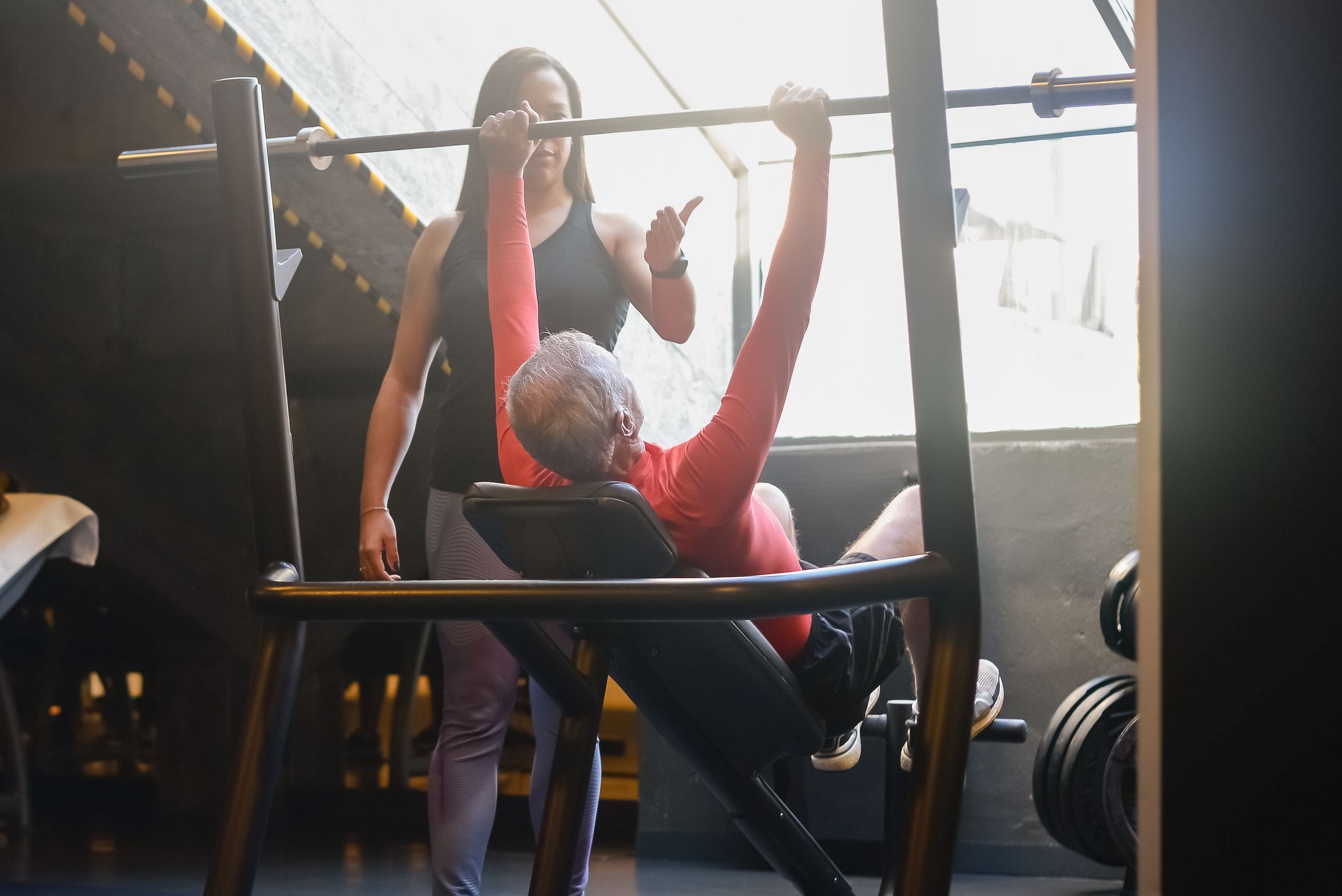
Train the major muscle groups, including the legs, hips, back, chest, shoulders, and arms. Begin with a load and range you can control, then make the work more challenging over time.
Resistance can support strength, function, and site-specific bone loading. Bands, body weight, free weights, machines, and daily tasks can all work when the setup creates enough challenge safely.
Balance and functional practice
Practice standing, stepping, turning, reaching, rising, and recovering balance. The task must challenge balance enough to improve it while a counter, rail, chair, device, or therapist keeps the risk acceptable.
Walking and resistance work alone have uncertain fall-prevention effects. Balance and functional training deserve their own place.
Weight-bearing and impact
Walking, stairs, dancing, heel drops, hops, or jumps create different bone-loading signals. Higher impact may fit a strong, experienced person with lower fall and fracture risk. It may not fit very high fracture risk, particularly with a recent or multiple vertebral fracture history, or a person with joint limits or poor landing control.
A target such as a set number of impacts is a later program choice for selected people, not a universal starting prescription.
Back strength and movement skill
Back-extensor endurance and strength can support posture, function, and comfort. Hip-hinge, lifting, carrying, and turning practice help make strength useful outside the gym.
Exercise cannot reshape a healed compression fracture or guarantee another fracture will not occur. The goal is better capacity and safer choices within the current structure.
Spine-sparing without fear
Do not ban every bend or twist. Change the force, range, speed, or support.
A hip hinge manages spinal load; it does not remove load. The useful question is whether the movement is controlled and matched to the person's fracture risk.
Pick up a low object
Move close, widen or stagger the feet, hinge through the hips, use a hand support when needed, and keep the object near the body.
A fast reach, a long lever, an end-range rounded spine, or a heavy object far from the body.
Carry groceries or laundry
Split the load, hold it close, clear the route, and choose a container and distance you can manage without rushing.
An uneven load, blocked vision, fatigue, stairs, a slippery path, or turning the trunk while the feet stay planted.
Turn with a load
Take small steps and turn the feet and body together. Pause before changing direction if balance is uncertain.
A sudden loaded twist, especially near the end of the available range or when the load is moving.
Use a machine or cable
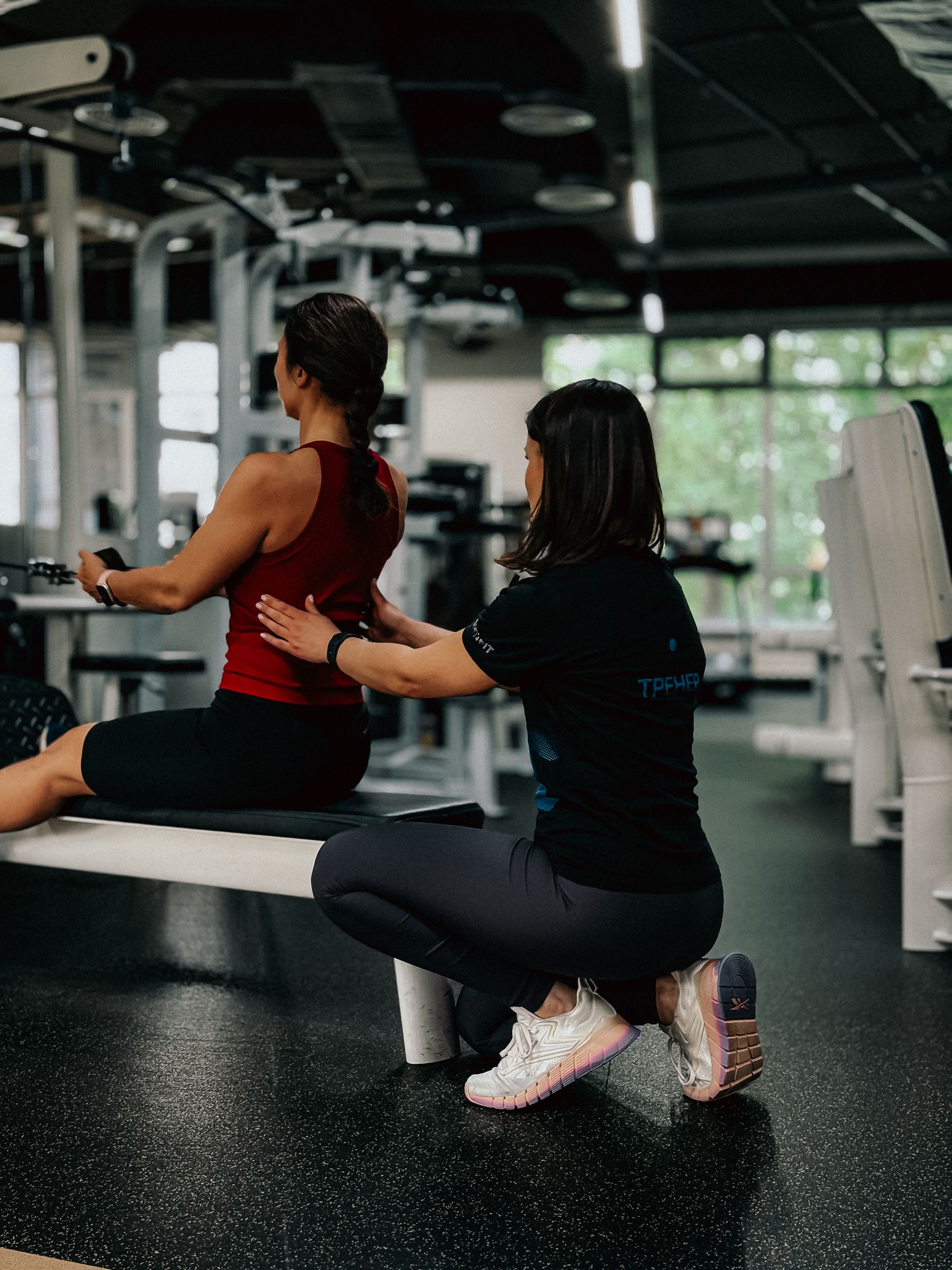
Fit the seat and handles, practice getting in and out, use a range you control, and stop the set before technique breaks down.
Poor equipment fit, a forced starting position, jerking, breath-holding, or a load that pulls you out of alignment.
Squat, hinge, or row
Choose a version, range, and support that match experience and risk. Learn the pattern with feedback before raising the load.
Copying an advanced protocol. High spinal compression, depth jumps, and heavy deadlift-type work do not fit very high fracture risk, particularly with a recent or multiple vertebral fracture history, without specialist direction.
Targets, not a starter prescription
Build toward meaningful work without forcing a universal number.
Guideline doses describe a useful destination for many people. A sedentary, painful, frail, recently injured, or unfamiliar person may need to start far below them.
Strength frequency
A common long-term target is resistance training on two or three days each week. Similar muscle groups need enough recovery, and other medical or rehabilitation plans may change the schedule.
Working sets
For a suitable person, build toward a load that feels challenging for about 8–12 controlled repetitions, often for two sets and sometimes three. This is not the first session, a requirement to train to failure, or a rule for every exercise.
Balance and impact
Balance and functional work often belongs on three or more days each week and can be practiced in short safe bouts. Impact dose depends on fracture history, fitness, joints, pelvic-floor needs, landing control, and fall risk.
No validated weekly percentage fits everyone. Load, repetitions, sets, range, speed, balance complexity, and impact are separate variables. Change the smallest useful one, then observe control, focal pain, fatigue, and later function before changing another.
Research headline, clinical context
The heavy-lifting study is not a home workout template.
What happened: In the LIFTMOR trial, 101 carefully screened postmenopausal women were randomized: 49 to supervised, twice-weekly high-intensity resistance and impact training for eight months and 52 to a low-intensity home program; per-protocol analyses included 43 women in each group.
What improved: Compared with control, high-intensity resistance and impact training produced better lumbar-spine and femoral-neck bone-density outcomes and improved physical function. Lumbar-spine bone density increased, while femoral-neck bone density was about maintained as the control group declined. One intervention-related minor low-back muscle strain occurred; the trial was not powered to establish safety.
What the trial does not prove: It does not show that anyone with osteoporosis can copy heavy 5-by-5 lifting and jumps without screening, coaching, preparation, or modification. Nor does one trial establish that higher intensity is generally better for bone density. A 2026 meta-analysis in older adults found greater leg-strength gains with higher intensity, but no significant advantage for lumbar-spine or femoral-neck bone density.
How At Argan, we use it: Higher load is not automatically forbidden. It is a possible later tool for the right person. A recent fracture, focal pain, a recent or multiple vertebral fracture history, other signs of very high fracture risk, high fall risk, and important medical conditions change that decision.
Progress that can be explained
Know what changed and why the next step belongs.
I change one main variable at a time so we can interpret the response. Keep the exercise, support, and recovery steady while testing that planned change.
First, find the repeatable version
Choose the position, support, range, and load that allow controlled repetitions without new focal bone pain or unsafe balance loss.
Record enough to repeat it: exercise, load or band, repetitions, sets, support, symptoms, and the next-day effect on usual tasks.
Then, choose one variable
Add a small amount of load, one or two repetitions, a little range, another set, less hand support, or a small change in speed. Do not raise them all together.
This one-variable approach is a practical clinical method, not a proven universal rule.
Hold long enough to see the pattern
A useful change remains controlled across more than one session. Bone adaptation is slow, while muscle soreness, fatigue, sleep, illness, and daily activity can change quickly.
Do not use a short-term DXA scan to decide whether last week's load was correct.
Step back when the signal changes
Reduce the last variable, range, or complexity when technique worsens, balance becomes unsafe, ordinary tasks are meaningfully harder later, or symptoms no longer match the known plan.
A falling baseline, repeated near-falls, or no repeatable dose is a reason to reassess the cause.
Use the whole response
Muscle effort and focal bone pain are not the same signal.
Continue the plan
The movement stays controlled, balance support works, expected muscle effort settles, there is no new focal spine, rib, hip, thigh, or groin pain, and usual function is steady later and the next day.
Hold or modify
Technique changes, breath-holding becomes hard to avoid, balance is uncertain, soreness is more than expected, or the session causes a meaningful loss of function. Return to the last repeatable setup and review the variable that changed.
Stop and assess
New sharp or focal pain, pain with weight-bearing, sudden height or posture change, new numbness or weakness, a fall with injury, or symptoms outside the known plan are not ordinary training responses.
Exercise is one part of fracture care
Medication, nutrition, scans, and strength work answer different questions.
Medication
Exercise does not replace medicine when treatment is indicated. Do not stop or delay denosumab or another osteoporosis medicine because you feel stronger or a scan improved. Medication changes need a prescriber-led plan.
Calcium, vitamin D, and food
Bone and muscle need adequate nutrition, but supplement needs are individual. More is not automatically better. Review diet, kidney history, medicines, and lab results with the medical team before using a generic dose.
DXA and fracture review
Ask what the scan means in the context of prior fractures, age, falls, glucocorticoids, and other risks. Repeat testing should have a management purpose and, when possible, use the same facility and DXA system. Results from different systems should only be compared after proper cross-calibration.
Home and route safety
Lighting, footwear, vision, rugs, pets, stairs, rushing, and the way equipment is stored can change fracture risk. Strength gains matter most when the environment also supports safe practice.
How At Argan, we assess safe strength
I connect the scan and fracture history to the movement you need.
We review the diagnosis, DXA and fracture reports that are available, recent pain, medicines and medical limits, falls, balance, daily tasks, prior training, and the equipment you can use. Then At Argan, we test strength, gait, transfers, balance, lifting shape, and the exact movement that feels uncertain.
The plan may start with a supported sit-to-stand, a band, a machine, a free weight, a carry, a step, or a back-extensor exercise. The label matters less than the measured dose and the response. Argan can also show how to hinge, turn, lift, carry, and set up a home or gym routine without turning normal movement into something frightening.
Common questions
Strength training with osteoporosis: practical answers.
Can I lift weights if I have osteoporosis?
Usually, yes. Progressive resistance training is a core part of osteoporosis exercise guidance. The safe version depends on fracture history, current pain, balance, experience, medical limits, technique, and the load. Recent or painful fractures, multiple vertebral fractures, advanced disease, frailty, or repeated falls call for an individualized plan first.
How heavy should I lift?
There is no universal pound limit or T-score formula. Start with a load, range, and setup you can control. For suitable patients, guidelines often build toward challenging sets of about 8–12 repetitions for major muscle groups. That is a destination, not a first-session requirement, and training to failure is not needed.
Are squats and deadlifts safe with osteoporosis?
The movement name is not enough. A supported squat to a chair is different from a deep heavy squat. A taught hip hinge is different from repeated loaded spinal flexion. Some well-screened people can use compound lifts under supervision. People at very high fracture risk, particularly with a recent or multiple vertebral fracture history, should avoid high spinal-compression work, including heavy deadlift-type exercise, unless a specialist directs the plan.
Should I avoid all bending and twisting?
No. Bending and turning are normal parts of life. Risk rises with rapid, repeated, sustained, end-range, or heavily loaded spinal flexion and abrupt loaded rotation, especially after a vertebral fracture or when fracture risk is very high. Use a controlled range, hinge at the hips for loaded bending, keep objects close, and turn with the feet when carrying.
Is walking enough for osteoporosis?
Walking supports general health, mobility, and weight-bearing activity. It usually should not replace resistance and balance training. A complete plan may also include appropriate impact, back-extensor work, and functional practice. The impact choice changes with fracture history, joints, landing control, and fall risk.
Can exercise reverse osteoporosis?
Exercise may modestly preserve or improve bone density at specific sites and can improve strength, balance, function, and confidence. It does not guarantee a better T-score, cure osteoporosis, or make a person fracture-proof. It works alongside medical treatment, nutrition, and fall prevention.
What changes after a vertebral compression fracture?
A vertebral fracture does not mean no exercise. Progressive leg, hip, back-extensor, balance, gait, and daily-task work can help. Recent, painful, multiple, or symptomatic fractures need individualized rehabilitation. High impact, high spinal compression, and repeated or loaded end-range flexion may need modification. Exercise cannot straighten a fixed fracture.
Do I need an X-ray or medical clearance before I exercise?
Not everyone does. Most stable people can remain active without a routine pre-exercise spine X-ray. Assessment is appropriate for suspected fracture, new focal pain, painful or multiple vertebral fractures, repeated falls, important medical conditions, recent surgery, or uncertainty about higher loading. Imaging checks a clinical concern; it is not a generic workout permit.
Selected clinical sources
- DVO exercise guideline for fracture prevention (2026).
- Strong, steady and straight UK consensus (2022).
- Bone Health and Osteoporosis Foundation clinician guide (2022).
- Osteoporosis Canada clinical practice guideline (2023).
- NOGG exercise and falls guidance and vertebral-fracture guidance (2024).
- Too Fit To Fracture exercise recommendations (2014).
- LIFTMOR randomized trial (2018).
- Exercise and bone density meta-analysis (2023); exercise and fracture meta-analysis (2023).
- Higher- versus lower-intensity resistance meta-analysis (2026) and exercise safety review (2018).
- Royal Osteoporosis Society safe exercise guidance (reviewed 2026).
- International Society for Clinical Densitometry official positions (2023).
- NIH NIAMS osteoporosis signs and care; AAOS spinal-fracture guidance.
- APTA Geriatrics fall-risk clinical practice guideline (2025).
A measured next step
Argan can help turn osteoporosis advice into a strength plan you can use.
Argan provides one-on-one mobile outpatient physical therapy in Southlake, Colleyville, and selected nearby DFW addresses. Argan can review the available fracture and DXA information, measure strength and balance, teach lifting and daily-task strategies, and build a practical home or gym progression. Availability depends on the address, route, schedule, and care needs.
Educational information only; not a diagnosis, fracture evaluation, emergency service, medication plan, or substitute for individualized medical care. Evidence reviewed through August 5, 2026.